Fake a Player does not currently have a fully verified public map directory. The strongest named clue is Huss Valley, which appears in a video title, while other available map information describes map features and repeated map selection without confirming formal names. Use this page as a practical map-reference guide: it tells you what is supported, what remains unconfirmed, and which terrain features matter during a chase.
Fake a Player map reference
The table below separates named map information from usable scene and route clues. A clue can help you make a decision in a match without proving that it is an official map name or a map-exclusive mechanic.
| Map or scene clue | What is supported | How to use it |
|---|---|---|
| Huss Valley | A video title identifies this as a map scene; its layout, obstacles, win conditions, and fixed routes are not confirmed. | Treat it as a named map lead, then learn the live layout instead of relying on an assumed route. |
| Repeated or next-map selection | Subtitles describe receiving the same map again and wanting to move to the next map, but no rotation order or map list is supplied. | If the same scene returns, adjust your route plan rather than assuming the next selection is guaranteed. |
| Indoor house scene | Rooms, a living room, stairs, a basement, and upper/lower levels are described in one gameplay video; the formal map name is not confirmed. | Check exits and level changes before committing to a chase route. Do not treat the scene as a named map entry yet. |
| Walls, corners, and looping space | Videos describe corner attacks, looping, and a pursuer hitting a wall during a chase. | Use turns and obstacles to break a direct line, but verify that the route remains open before looping. |
This is a reference of currently supported map information, not a promise that every clue appears in every round. The game’s live map display and the geometry in your current match take priority over a remembered callout.
What the map evidence tells you
Huss Valley is the only supplied map clue presented as a specific proper name. That makes it useful for recognizing a likely map reference, but not enough to publish a detailed walkthrough. The available record does not establish its size, spawn points, room list, objective locations, escape routes, or a guaranteed winning loop. If you enter a map called Huss Valley, treat your first pass as reconnaissance: note the nearest turn, a backup direction, and whether a wall or obstacle actually gives you space to change direction.
The remaining clues describe how players talk about maps during matches. One video mentions selecting the same map again and wanting to go to the next map. This supports repeated map appearances and a player preference to change scenes, but it does not reveal whether the game uses voting, a fixed rotation, random selection, or another rule. No reliable map count or order is available here. A repeated scene is therefore a normal possibility, not proof that a particular map is next.
An indoor house scene is also described through rooms, a living room, stairs, a basement, and upper and lower levels. Because the video does not tie those labels to a formal map name, use them as spatial landmarks only when you can see them in the current round. They may help you communicate a position or choose a direction, but they should not be presented as a confirmed Huss Valley layout.
How to read a map in a chase
Start by locating two kinds of space: a route that lets you turn and a route that lets you disengage. A corner can create a sudden change in direction, while a wall or obstacle can interrupt a direct approach. A looping area can keep a pursuer moving around the same structure, but it becomes unsafe if the exit is blocked or another player approaches from the opposite side.
When you are being chased, avoid spending all of your movement options at the first turn. Keep enough room to change direction, and check whether the next room, stairwell, or corridor has a second exit. If the pursuer knows your position, a predictable loop may give them time to cut you off. The supported chase examples point to sharp turns, looping, and forcing a pursuer into a wall; they do not establish that any one move guarantees an escape.
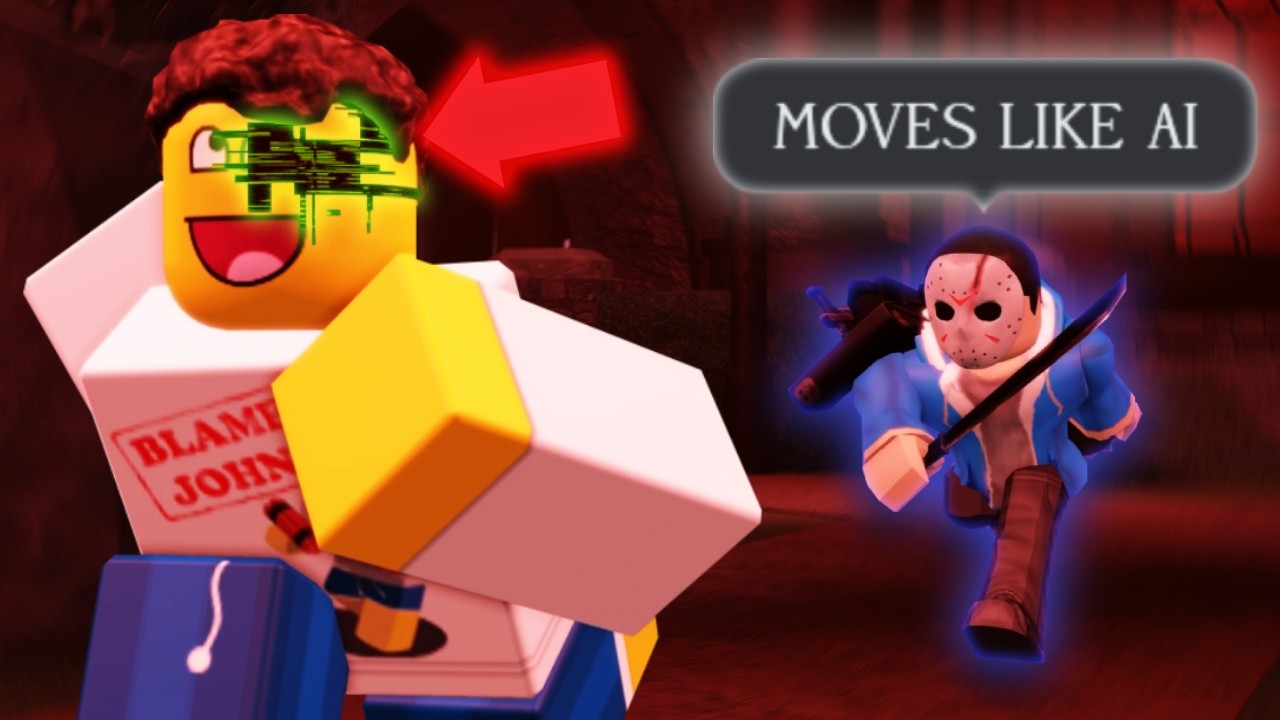
Use corners and loops during a Fake a Player chase
This moment supports the section's advice about corner attacks, looping, and changing direction when the pursuer knows your position.
Use vertical changes carefully. Stairs and upper/lower areas can alter the pursuer’s approach, but the available evidence does not confirm whether every level is accessible, whether a basement is present on a named map, or whether changing floors provides a special advantage. Before descending, identify where you can turn back. Before climbing, check whether the upper area ends in a dead end.
For a pursuer, the same geometry changes the priority. Corners can create attack opportunities, while a wall impact or a failed turn can give the target time to widen the gap. Do not follow a player through a loop without checking the exit and surrounding routes. The evidence supports using map space for pursuit and juking, but it does not confirm special map abilities for Slasher, Infector, Survivors, or any other role.
Map decisions for common situations
The same map appears again
Use the repeat as a chance to correct one route decision. If you were trapped in a room, identify the earlier turn that removed your backup exit. If you were caught on a loop, locate a wider area where you can change direction before the pursuer closes the gap. The record does not confirm a button or rule that guarantees a different next map, so do not plan around an assumed rotation.
You enter an unfamiliar indoor area
Spend the first safe moment identifying the nearest room exit, stair direction, and open space. Keep the landmarks that you can actually see—such as a living room, stairs, or basement entrance—in your callout. Avoid claiming that a location is part of a named map until the game itself identifies it.
A pursuer corners you
Turn before contact if the geometry allows it, then choose the route with a visible continuation rather than the narrowest-looking gap. If a wall or obstacle can make the pursuer overshoot, use it as a timing tool, not as a guaranteed stun or block. If the route closes, stop repeating the same loop and move toward your backup exit.
Use walls to break a Fake a Player chase
This moment supports the section's advice about using a wall or obstacle as a timing tool during a chase without treating it as a guaranteed stun.

You are watching after elimination
Spectating can teach map timing without requiring a formal map guide. Watch when another player leaves a room, how early they turn, and whether they preserve an alternate exit. Compare that decision with the point where the pursuer gains a direct line. This can improve your next round even when the map’s official name or full layout is unknown.
What is not confirmed yet
There is no verified public list here for the total number of Fake a Player maps, their rotation order, voting rules, fixed spawn points, objective locations, or map-specific victory conditions. The available wiki indexes do not provide a usable map catalog, and the current record does not establish a complete layout for Huss Valley.
Do not turn ordinary collision into a named map mechanic. A player hitting a wall can reflect a chase interaction, a difficult angle, or an operating mistake; it does not by itself prove that the wall belongs to a special trap or that the map grants a unique effect. Likewise, rooms and floors described in a video should remain scene clues unless the game identifies their map.
The safest way to use this page is to combine the confirmed callouts with live observation. Check the current map name when one is shown, learn the geometry of the round in front of you, and update your route choices when the same scene returns. Until a complete directory is published or verified, that approach is more reliable than memorizing unsupported map names or a presumed rotation.
First-time Fake a Player map questions
Is Huss Valley a confirmed full map guide?
Huss Valley is supported as a map name in a video title, but its complete layout, routes, and map-specific rules are not confirmed here. Use the live map geometry rather than assuming that every described indoor feature belongs to Huss Valley.
Does Fake a Player have a confirmed map rotation order?
No. The available map information describes seeing the same map again and wanting to move to the next map, but it does not establish voting rules, a fixed order, or a guaranteed next selection.
What should I look for first on an unfamiliar map?
Find a turn, an alternate exit, and any visible stairs or level change. Those landmarks help you avoid dead ends and choose a recovery route when a pursuer closes the direct path.